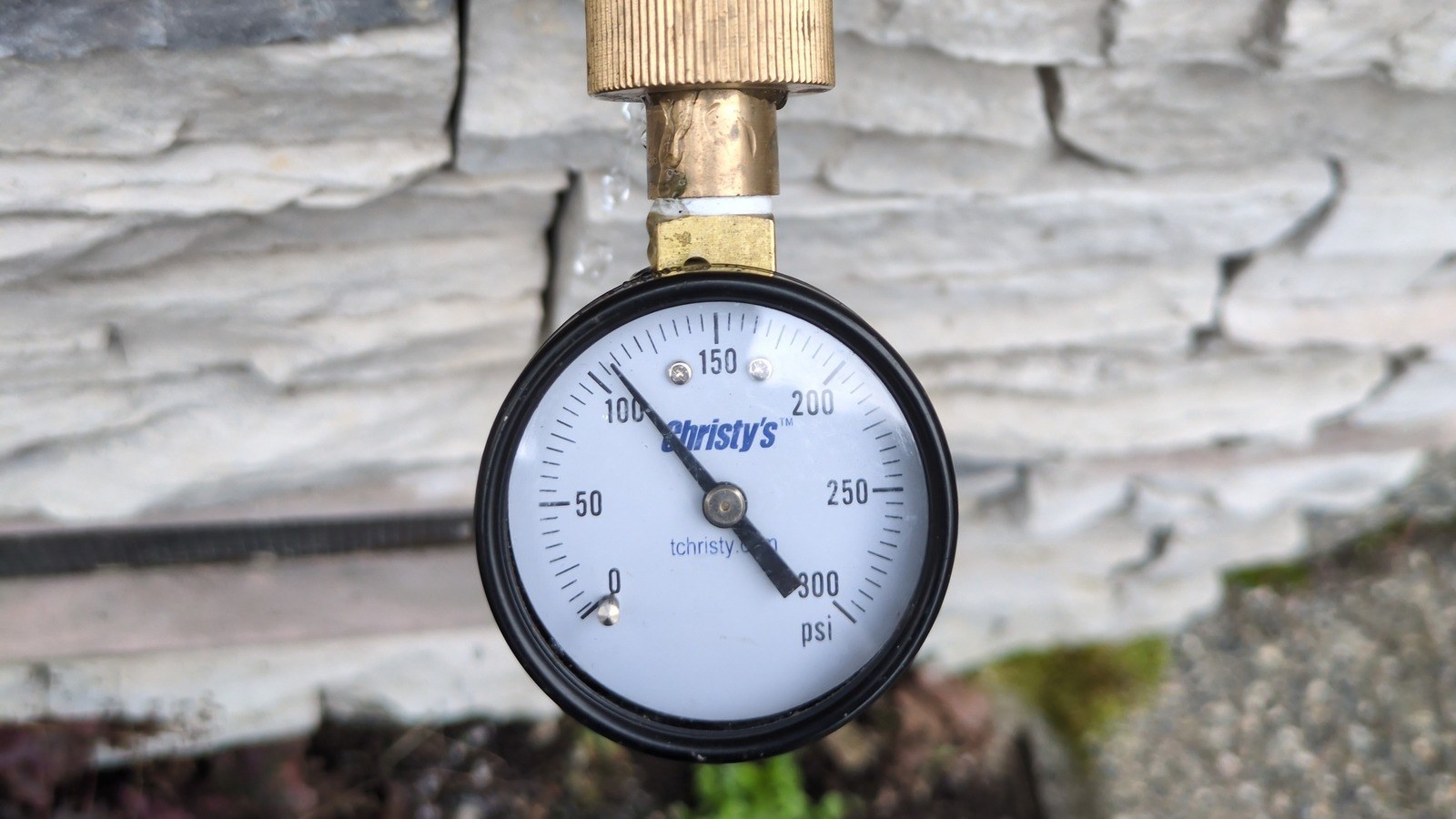
Between 50 and 70 psi suits most homes, and Washington's plumbing code requires a regulator once pressure tops 80. Plenty of houses run higher than their owners think: on recent visits our gauge read about 105 psi in Silver Firs, 110 in Edmonds and 90 in Meadowdale.
What should my water pressure be?
For most homes, somewhere between 50 and 70 psi. That is plenty for a shower upstairs and a sprinkler at the same time without straining valves, hoses and the water heater. Washington's plumbing code requires a regulator when pressure tops 80 psi, and anything under about 40 starts to feel weak at the fixtures.
How do I check my water pressure at home?
Buy an inexpensive pressure gauge that threads onto a garden hose fitting, screw it onto the outdoor faucet closest to where the water line enters the house, make sure nothing inside is running, and open the faucet fully. The needle shows your static pressure. Check once in the morning and once late at night, when it often reads highest.
Is high water pressure bad for my house?
Yes, though the damage is slow. Pressure above 80 psi wears on everything with a seal or a spring: toilet fill valves, faucet cartridges, washer and dishwasher hoses, supply lines and the water heater's relief valve. In February we replaced the laundry shutoff valves and a failed outdoor faucet at an Edmonds house running at 110 psi.
Why did my water pressure suddenly drop everywhere?
When every fixture goes weak at once, the cause is upstream of all of them. The usual suspects are a pressure regulator that has failed partly closed or clogged its strainer, a main shutoff that was bumped or never fully reopened after work, a leak on the water service, or the utility working on the main.
Why is the pressure low at only one faucet or shower?
Because the problem is in that fixture, not the house. Usually it is a clogged aerator in the spout, a shower head blocked with debris, or a worn cartridge inside the valve, and sometimes it is the shutoff under the sink that was never opened all the way. None of it involves the regulator or the water line.
Where is my pressure regulator?
Usually near where the water line enters the house: on the garage wall, on the riser in a crawlspace, in the basement beside the main shutoff, or in a box next to the meter. Look for a bell-shaped brass valve, often with an adjusting bolt on the end, a few feet from the main shutoff. Some houses never had one.
On recent jobs we have put new ones in all four places: a Wedgwood garage, a north Kirkland crawlspace, a Shoreline basement and a meter box in Mill Creek.
Why do my pipes bang when a faucet or washer shuts off?
That bang is water hammer: water moving through the pipe stops suddenly when a valve snaps shut, and the shock wave rattles the pipe against its supports. High pressure makes it worse, so the first fix is often bringing the pressure down. Where it persists at a washer or dishwasher, small arrestors at the valve absorb the shock.
Why does the relief valve on my water heater drip?
Usually because pressure in the house has nowhere to go. When a regulator or check valve closes the system, heated water expands every time the heater runs, and without a working expansion tank the relief valve releases it. Pressure that is simply too high does the same. Either way, test the pressure before replacing the valve.
Our Recommendation
Test your pressure once a year and after any work on your street. If the gauge reads over 80, a regulator is not optional, and if you have one and the reading is creeping up, it is worn out. Set the house between 50 and 70 and keep a charged expansion tank on the water heater.
Get Your Pressure Checked
Call for a free estimate, or request a callback. We bring the gauge and tell you what your house is really living with.
Related: water pressure and PRV service · water heater installation · main water line repair · leak detection · the fall plumbing checklist · plumbing in Mill Creek