
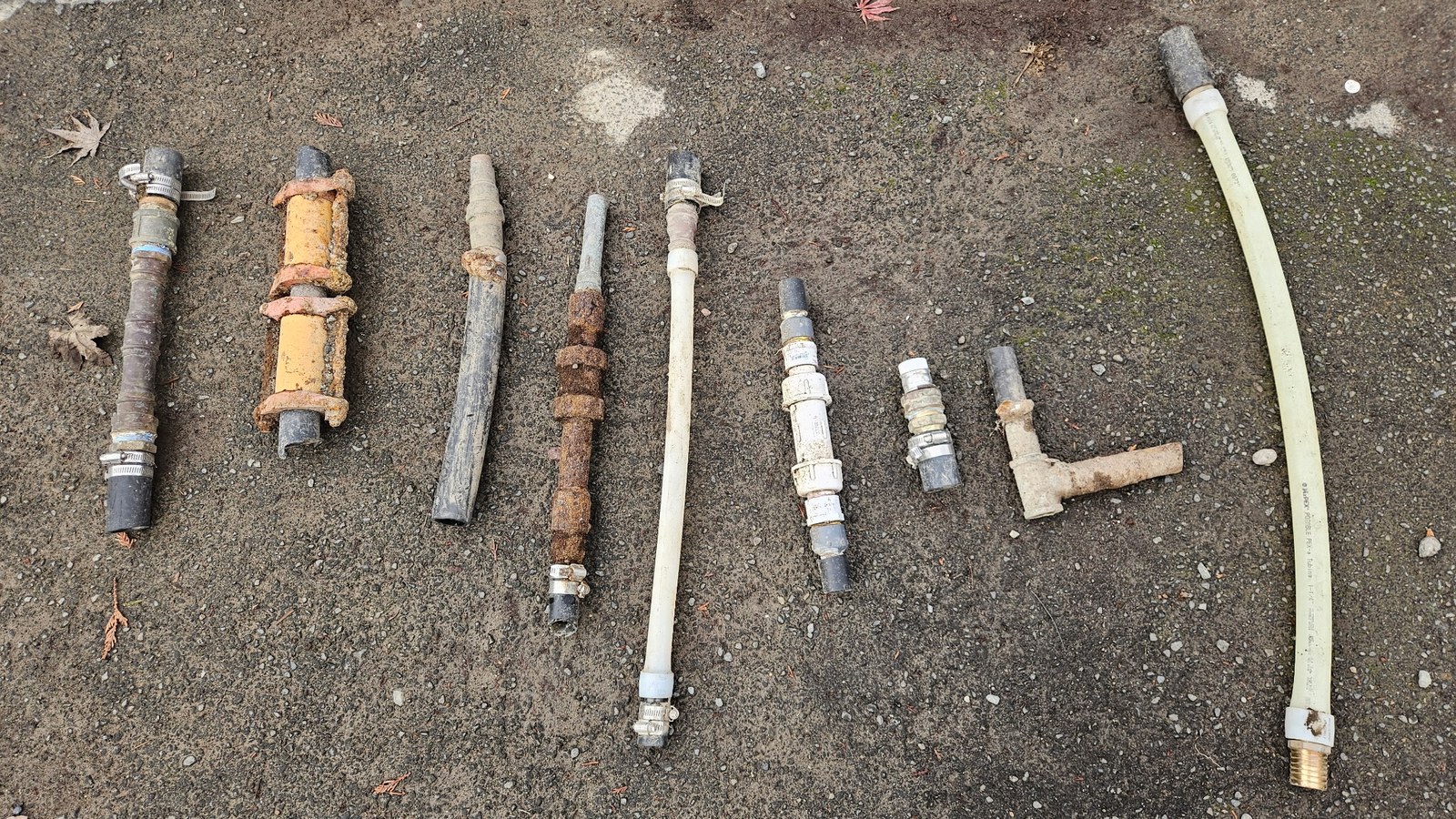
Many water service lines we dig up have been repaired before, and the repairs come in a handful of kinds: hose clamps on barbed couplings, bolted repair clamps, compression couplings, threaded galvanized fittings and short sections of new pipe spliced in. Each can stop a leak. None of them makes the old pipe around it any younger.
The photo above is a row of them: short lengths of old service line, each with a past repair still on it. Here is what each kind is, what it was meant to do, and what it tells us when we find one on your line.
1. Hose clamps on barbed couplings
Black poly, the polyethylene pipe used for many service lines in houses built from the 1960s to the 1990s, is joined with barbed insert fittings pushed inside the pipe and held with stainless hose clamps. That is the standard way poly was put together, and it is also where poly lines leak: the clamps rust, the barbs crack, and the pipe hardens around them until it no longer seals. Several pieces in the photo show it, some with two clamps stacked where one stopped holding.
2. Bolted repair clamps
A repair clamp is a metal band lined with a rubber gasket that bolts around the pipe over the leak. It is a fast way to get the water back on, and on a sound pipe with a single pinhole it can last. The clamps on the second piece in the photo have rusted orange, and a second clamp set beside the first is a sign the pipe kept failing next to the repair.
3. Compression couplings
A compression coupling slides over two pipe ends and seals with gaskets squeezed tight by its nuts, so a damaged piece can be cut out and a new one spliced in. The white plastic couplings in the photo did that job on a poly line. They depend on the gasket and the grip of the nut, and ground that settles or shifts can work a joint loose over the years.
4. Threaded galvanized fittings
Galvanized steel nipples, couplings and tees turn up where a line was first built in steel, or where steel parts were used to join it to something else. Steel rusts from the outside in, and the threads, where the wall is thinnest, go first. The rust-covered pieces in the photo are typical of what comes out of the ground, and our post on why galvanized water lines fail explains the rest.
5. A new section spliced in
The best spot repair is a new length of pipe rather than a patch over the old one. When we make a spot repair, we cut out the failed section and join new PEX A to the old pipe with brass fittings. On Queen Anne in June, that meant replacing a leaking section of 1-inch PVC service at a fence line and setting it two feet down, and in Alderwood Manor the crew spliced PEX into a 1½-inch service about four feet below the asphalt. The length of PEX tubing at the end of the row is that kind of repair, though even a good splice is joined to old pipe at both ends.
6. Replacing the line
The only repair that leaves no old pipe behind is a new line from the meter to the house: one continuous run of PEX A with a tracer wire, bored under the yard with our own drill when the lot calls for it. Our trenchless water line replacement page shows how that works.
What a Line Full of Repairs Is Telling You
The next leak usually starts close to the last repair, because the pipe that failed there is the same age and material as the pipe on either side of it. On a December call in Kirkland, the leak turned out to be an old clamped splice letting go, with the original clamps still stacked on the section the crew pulled out. That is the pattern in this photo: one repair after another on lines that had run out of life.
Our owner Steve's rule on black poly is simple. Black poly in houses built from the 1960s to the 1990s tends to fail at around 30 to 40 years old, and once a poly line starts leaking it has reached the end of its life, so we recommend replacing it rather than patching it. Galvanized steel and polybutylene fail on a schedule too. A spot repair still makes sense on a line whose material has years left in it, as the PVC on Queen Anne did.
Spot repairs on a buried service usually run $2,000 to $6,000, and full meter-to-house replacements $6,000 to $16,000, with the length of the run, its depth and what it passes under moving the number. We price both when both are reasonable, so you can compare.
Water Service Repair Questions
Is a repair clamp a permanent fix for a leaking water line?
On sound pipe with one pinhole, a clamp can hold for years, but it stops a leak rather than fixing the pipe around it. Its band rusts, its gasket ages, and on black poly or galvanized steel the next leak usually starts nearby. We treat a clamp as a reason to check the line.
Why does my water line keep leaking next to the last repair?
Because the pipe beside a repair is the same age and material as the piece that failed. A clamp or coupling fixes one spot, but the brittleness or corrosion that caused the first leak is still working on the rest of the run. Two leaks close together on one line usually mean the pipe itself is done.
What does Done Right use for a spot repair?
We cut out the failed section and join in new PEX A on brass fittings rather than clamping over the leak, and where the old line is too shallow we set the new section deeper. Our spot repairs carry a two-year warranty on the new section, and on black poly we price a full replacement beside the repair.
How can I tell if my water line has been repaired before?
Often you cannot from above. Look in the meter box, and where the line enters the crawlspace or basement, for clamps, couplings or a change in pipe color, and check any records from when you bought the house. When we dig at a leak, we tell you what we find on the line, old repairs included.
Our Recommendation
If your line is black poly and it has leaked, replace it. If it is galvanized steel or polybutylene, plan the replacement before the next leak picks the date for you. If the material is sound and the failure is in one place, a properly made spot repair in new pipe is a good repair, and we will tell you which case you are in before you pay for either.
Call About a Water Line Leak
A soggy patch in the yard, a meter that turns with every tap closed, or a line that has been patched before? Call for a free estimate, or request a callback.
More: main water line repair · trenchless water line replacement · outdoor leak detection · signs your water line is failing · water service pipe materials · what a water line replacement costs